
How to clean a handpan: the complete step-by-step guide
Learn how to clean handpan safely with simple steps, the right oil, rust prevention tips and expert care advice to protect its sound and finish.

Table of contents
A handpan is more than a musical instrument. It is a handcrafted sound sculpture, shaped with precision, tuned by ear and often chosen with a strong emotional connection. Whether you play at home, perform outdoors or take your instrument to workshops, proper care is essential if you want to preserve, appearance and long-term value.
Because a handpan is made of steel, it reacts to sweat, moisture, dust and changes in temperature. The good news is that cleaning a handpan is not complicated once you understand the right routine. With a soft cloth, the correct cleaning product and a small amount of protective oil, you can keep your instrument in excellent condition for years.
This guide explains how to clean a handpan safely, how often to oil it, how to prevent rust and what to do if small rust spots appear.
Why regular cleaning is essential for your handpan
Regular cleaning protects the surface of your handpan. Every time you play, your hands leave behind sweat and tiny particles of dust. These residues may seem harmless at first, but over time they can weaken the protective layer of the steel and increase the risk of corrosion.
Cleaning is especially important if you play outdoors, live in a humid climate, store your handpan in a case for long periods or use the instrument frequently. A quick wipe after each playing session and a deeper clean from time to time can make a major difference to the lifespan of your instrument.
How sweat and moisture attack the steel
Sweat contains salt, and salt is one of the main enemies of untreated or poorly protected steel. When salty residue stays on the surface of a handpan, it can react with moisture in the air. This reaction gradually encourages oxidation, which appears as small orange or brown rust spots.
The risk is higher after long playing sessions, outdoor performances or travel. Even clean hands produce natural oils and moisture, so it is worth building a simple routine: play, wipe, dry and store correctly. This small habit is often enough to prevent most surface problems.
Stainless Steel vs Nitrited Steel: does it change your cleaning routine?
The short answer is no. The fundamental cleaning routine remains essentially the same for both materials.
A common misconception is that stainless steel requires no care at all, while nitrided steel needs constant, high-maintenance protection. In reality, modern nitriding is an advanced thermo-chemical process that hardens the steel and creates a remarkably tough, corrosion-resistant surface barrier. When crafted correctly, nitrided steel resists sweat and humidity just as effectively as stainless steel.
However, the two materials do have subtle maintenance preferences that are worth keeping in mind:
- Nitrided steel handpan care: because the nitriding process creates a micro-textured, hardened surface, it absorbs protective oils very well. Your routine involves wiping off sweat with a microfibre cloth after every session, cleaning off grease with isopropyl alcohol when needed, and applying a thin layer of specialist handpan oil to keep the protective seal active.
- Stainless steel handpan care: stainless steel is naturally more resistant to rust due to its chromium content, so it generally requires less protection against corrosion. However, sweat, skin oils, salt, and dirt can still leave marks on the surface and may affect its appearance over time.
- After playing, we recommend wiping the entire surface with a clean, dry microfibre cloth to remove any residue. For regular care, a small amount of suitable handpan oil can be applied with a microfibre cloth approximately every 2–4 weeks. This helps protect the surface and keeps the instrument in good condition.
- Ultimately, neither material is maintenance-free. Both stainless and nitrided handpans react to sweat and atmospheric salt. The gold standard for both remains the exact same simple habit: wipe down after playing, clean with alcohol when greasy, and dry completely before storing.
The impact of poor maintenance on your handpan's sound quality
While a light layer of dust, fingerprints, or protective oil will not magically deaden your instrument's tuning, neglecting surface care over a long period can lead to preventable problems.
Accumulated sweat and salt left on the steel eventually turn into surface oxidation. If left untreated for months or years, surface rust can slowly eat deeper into the metal (a process known as pitting corrosion). Deep corrosion alters the physical mass and structural integrity of the tone fields, which can ultimately compromise tuning stability and require professional restoration.
The handpan’s sound depends on the precise vibration of its steel surface. If that surface is dirty, sticky or corroded, the instrument may lose some of its brightness and sustain. Serious corrosion can also affect tuning stability, which is why prevention is far easier, cheaper and safer than repair.
Common mistakes to avoid when cleaning a handpan
Cleaning a handpan is simple, but using the wrong approach can cause damage. Many problems come from treating the instrument like ordinary metalware. A handpan is not a pan, a cymbal or a decorative steel object. It is a tuned instrument with a delicate surface that needs gentle handling.
The most common mistakes are using abrasive cloths, applying harsh cleaners or using too much oil. Each of these can harm the protective layer, attract dirt or interfere with the instrument’s natural resonance.
Using the wrong type of cloth
The safest option is always a clean, soft, lint-free microfibre cloth. Abrasive towels, rough kitchen cloths or low-quality fabrics can create fine scratches on the surface. These scratches may be barely visible at first, but they can weaken the protective finish and create places where moisture collects.
Keep at least two cloths for your handpan: one for cleaning and one for oiling. This avoids mixing alcohol, dust and oil in the same fabric. It is also worth washing or replacing your cloths regularly so you are not rubbing old residue back onto the instrument.
Overusing alcohol or harsh cleaners
Isopropyl alcohol can be useful for removing sweat, grease and surface residue, but it should be used carefully. The key rule is simple: apply it to the cloth, never directly onto the handpan.
Avoid household cleaners, bleach, detergents, glass sprays and aggressive degreasers. These products are not designed for tuned steel instruments and may strip away protective oils or damage the surface. A handpan needs targeted care, not heavy cleaning.
Applying too much oil
Oil protects the steel from moisture, but more oil does not mean more protection. Applying too much can create a sticky film that attracts dust, fingerprints and dirt. It may also make the handpan uncomfortable to play and, in some cases, slightly affect the way the surface vibrates.
The goal is a very thin, even layer. After applying handpan oil, always buff away any excess with a clean cloth. The instrument should feel protected, not greasy.
What you need before you start: tools and products
Before cleaning your handpan, prepare everything you need. This avoids stopping halfway through the process or using an unsuitable product because it is nearby.
For a safe handpan cleaning session, you will need a clean microfibre cloth, isopropyl alcohol, a second dry cloth and some handpan oil.
Recommended cleaning cloths and applicators
Use soft, lint-free microfibre cloths for the outer shell, tone fields and inner surface. A good cloth should glide over the steel without leaving fibres behind. For small areas, a soft cotton applicator can help you work gently and precisely.
Avoid anything rough, metallic or textured. Steel wool, abrasive pads and scouring sponges should never be used on a handpan. Even if you are trying to remove dirt or rust, harsh rubbing can damage the surface and make the problem worse.
Which handpan oil should you use?
Specialist handpan oils are designed to protect the steel without leaving heavy residue.
The right choice may depend on your instrument’s steel type, your local climate and how often you play. If you own a standard nitrided steel handpan, you may need to oil it more regularly than a stainless steel model.
Products and chemicals to avoid completely
Some products should never be used on a handpan. Bleach, WD-40, steel wool, water-based household sprays, kitchen degreasers and bathroom cleaners can all damage the surface or interfere with the protective layer.
WD-40 is sometimes mistakenly used because it is associated with metal care, but it is not a specialist handpan oil. Household sprays can also leave residues that are difficult to remove. When in doubt, keep the routine simple: microfibre cloth, isopropyl alcohol used sparingly and a proper handpan oil.
How to clean your handpan: the step-by-step process
The best way to clean a handpan is to work slowly and gently. Choose a dry, clean space with good ventilation. Place the instrument on a soft surface or on your lap, making sure it cannot slip or be knocked.
The following five-step process is suitable for regular maintenance. If your handpan has serious rust, deep marks or tuning problems, do not scrub aggressively. In that case, contact a handpan specialist before attempting any stronger treatment.
Step 1 - Remove surface dust and debris
Start with a dry microfibre cloth. Wipe the entire outer surface using gentle circular motions. This removes dust, loose particles and fingerprints before any liquid is applied.
Do not press hard on the tone fields. A handpan is strong enough to be played, but its tuned areas should still be treated with respect. Light pressure is enough for regular dust removal. Pay attention to the central note, the spaces between tone fields and the outer rim, where dust can collect.
Step 2 - Wipe down with isopropyl alcohol
Apply a small amount of isopropyl alcohol to a clean cloth. The cloth should be lightly damp, not wet.
Wipe the outer surface in smooth, circular motions. Focus on areas touched most often by your hands. This helps remove sweat, grease and residue that a dry cloth cannot fully lift. Do not soak the surface and do not let liquid pool around the notes or edges.
Once you have wiped the full surface, move quickly to drying. Alcohol evaporates faster than water, but it is still important not to leave unnecessary moisture on the instrument.
Step 3 - Dry the surface completely
Drying is one of the most important steps in the whole process. Any remaining moisture can increase the risk of rust, especially on standard steel handpans.
Use a fresh, dry microfibre cloth to buff the entire surface. Then leave the handpan in a warm, well-ventilated room for a short time before putting it back in its case. Avoid drying it in direct sunlight, near a radiator or in extreme heat, as sudden temperature changes are not ideal for the instrument.
Step 4 - Apply handpan oil for protection
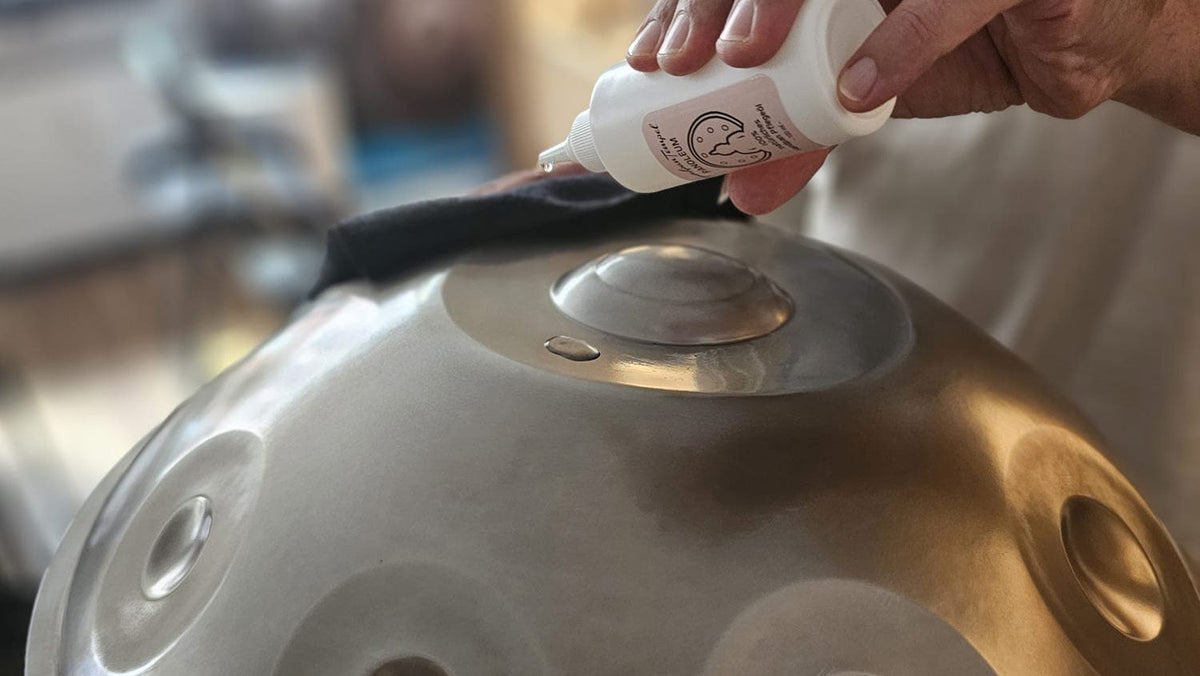
Once the handpan is clean and completely dry, apply a thin layer of specialist handpan oil. Add a small amount of oil to a clean cloth and spread it evenly across the surface. Use gentle circular movements and avoid applying too much product.
After oiling, take another clean cloth and buff away any excess. The surface should have a subtle protective finish, not a visible greasy layer. If your fingers slide too much or the instrument feels sticky, you have probably used too much oil.
How to prevent rust on your handpan
The best approach is a combination of regular wiping, controlled oiling, smart storage and careful handling.
Rust prevention does not require a complicated routine. It simply requires consistency. A few minutes of care after each session can prevent long-term problems.
How often should you fully clean your handpan?
How often you fully clean your handpan depends on how frequently you play and where you use it. If you play occasionally at home, a full clean every few weeks may be enough, combined with a quick wipe after each session.
If you play daily, perform outdoors, attend workshops or live in a humid area, you may need to clean it more regularly. The goal is not to over-clean, but to remove sweat and moisture before they become a problem. If the surface feels sticky, looks dull or shows many fingerprints, it is time for a clean.
How often should you oil your handpan?
As a general rule, oil your handpan about once or twice a month in normal conditions. If you play outside, travel with your instrument or live in a humid environment, you may need to oil it more often. After heavy use, a light protective oiling can also be useful.
However, avoid oiling every day unless specifically advised by a specialist. Too much oil can create build-up and attract dust. A thin, regular layer is better than frequent heavy applications.
Handpan storage tips to minimise moisture exposure
Store your handpan in a clean, dry place away from damp rooms, direct sunlight and sudden temperature changes. A padded case protects the instrument during transport, but it should not always be used as long-term storage if the handpan is even slightly damp.
After playing outdoors, let the instrument return to room temperature and make sure it is fully dry before closing the case. Avoid storing it in basements, garages, bathrooms or near windows where condensation forms. If your home is humid, consider using a room dehumidifier or moisture absorber nearby.
Handling habits that protect your instrument long-term
Small playing habits can greatly reduce maintenance issues. Wash and dry your hands before playing, especially after applying creams or lotions. Avoid touching the surface with wet hands and do not place drinks near the instrument.
After each session, wipe the surface with a clean microfibre cloth. This quick habit removes sweat before it has time to react with the steel. If several people play the same handpan during a workshop or gathering, wipe it more frequently.
How to remove rust from your handpan
Rust can be worrying, but not every rust spot means serious damage. Small orange marks on the surface are often treatable if caught early.
The most important rule is not to panic and not to scrub aggressively. A handpan is a tuned instrument. Harsh treatment can cause more harm than the rust itself.
Identifying surface rust vs deep corrosion
Surface rust usually appears as small orange or brown spots. It may sit on top of the steel and can sometimes be reduced with gentle cleaning. If the handpan still sounds clear and the rust has not spread, the problem may be manageable at home.
Deep corrosion is different. It can appear as pitting, rough texture, dark marks or areas where the steel surface looks damaged. If rust is near a tone field and the sound has become dull, unstable or buzzing, professional advice is recommended.
Safe DIY rust removal for minor spots
For small surface spots, start gently. Apply a little isopropyl alcohol to a soft cloth and rub the affected area with light pressure. Use small circular motions and check the result frequently. Do not use steel wool, sandpaper or abrasive pads.
Once the spot has been cleaned, dry the area completely and apply a thin layer of handpan oil. This helps protect the treated surface and reduces the risk of rust returning.
Sound-Sculpture’s team can provide guidance on handpan care, recommended maintenance products and next steps for more serious issues. If your instrument needs professional assessment, it is always safer to ask before attempting a more aggressive repair at home.
Final take-away: how to clean a handpan
To clean a handpan safely, remove dust with a soft cloth, wipe the surface with isopropyl alcohol applied to the cloth, clean the inside carefully, dry the instrument completely and finish with a thin layer of specialist handpan oil. This simple routine protects the steel, helps prevent rust and keeps the sound clear and resonant.
A well-maintained handpan plays better, looks better and lasts longer. If you need advice on handpan cleaning, care products or choosing the right instrument, Sound-Sculpture can support you at every stage.
FAQ
You should wipe your handpan after every playing session to remove sweat, dust and fingerprints. A deeper clean with isopropyl alcohol and protective oil can usually be done every few weeks, depending on how often you play.
The safest method is to use a soft microfibre cloth, a small amount of isopropyl alcohol applied to the cloth, and a thin layer of specialist handpan oil.
It is best to avoid water, as moisture can increase the risk of rust, especially on standard steel handpans. If the surface becomes damp, dry it immediately with a clean microfibre cloth.
Wipe it after each use, keep it dry, apply a thin layer of handpan oil when needed, and store it away from humidity, direct sunlight and sudden temperature changes.

About the author

Founder of Sound-Sculpture & handpan expert
Related articles
Handpan tuning: how does it work?
Discover how a handpan is tuned: expert techniques, high quality tools and all you need to understand how your instrument has been built or can be restored!

Handpan musicians: 10 artists redefining the instrument
Discover 10 handpan musicians pushing the boundaries of this remarkable instrument, from viral pioneers to UK street performers shaping the modern scene!
Letter notation vs Solfege: a guide for the modern music
Confused by Do-Re-Mi vs A-B-C? Discover the differences between solfege and letters, their history, and why handpan players prefer one over the other.
Major scale vs minor scale: the complete beginner's guide
A guide for beginners on major scale vs minor scale: learn how their patterns work and which one suits your handpan playing style.